Smart kitchen lights turning on by themselves can be annoying, confusing, and a little creepy. One minute the room is dark, the next your ceiling lights or under-cabinet strips are glowing for no clear reason.
The good news: there is almost always a logical cause. Once you understand how smart lights behave and where to look, you can usually stop phantom activations in a few minutes. This guide walks through the most common reasons smart lights switch on by themselves and gives you step-by-step fixes, with examples from popular brands like Philips Hue, Kasa, LIFX, and more.
Use this as a troubleshooting checklist for your smart kitchen lighting so your lights only turn on when you actually want them to.
Why Your Smart Kitchen Lights Keep Themselves On
Understanding how smart lights actually work
To fix smart lights turning on by themselves, it helps to know what controls them behind the scenes. A smart light can be triggered by several layers at once:
- The bulb or switch itself – Many smart bulbs (Philips Hue, LIFX, Sengled) and smart switches (Lutron Caseta, Wemo, Kasa) have built-in settings for what they should do when they first get power or when a timer or scene runs.
- The app or hub – Apps like Philips Hue, Kasa, Tapo, SmartThings, Apple Home, or Alexa can run schedules, routines, and automations that send “on” commands at certain times or when conditions are met.
- Sensors – Motion sensors, door/contact sensors, and occupancy sensors can all tell your lights to turn on when they detect activity.
- Voice assistants – Alexa, Google Assistant, and Siri can receive commands from your voice, buttons, widgets, smart displays, and other automations.
- Power behaviour – Many smart bulbs have a setting that defines what they do after a power cut: return to last state, stay off, or always turn on.
When your kitchen lights come on by themselves, something in one of these layers is sending an “on” command, or the light is defaulting to an “on” state after a small power or network issue.
Why the kitchen is a common problem area for phantom activations
The kitchen is usually one of the most automated rooms in a home, which makes it a prime place for unintended light activations. Common kitchen setups include:
- Multiple light zones – Ceiling lights, island pendants, over-sink lights, under-cabinet strips, and pantry lights often share scenes and routines.
- High-traffic area – People and pets walk through constantly, triggering motion and door sensors more often than in other rooms.
- Appliance interference – Microwaves, fridges, and thick cabinetry can interfere with Wi-Fi or Zigbee/Z-Wave signals, sometimes causing disconnects and reconnects that trigger default behaviors.
- Whole-home routines – Many “Good Morning” or “I’m Home” routines include kitchen lights, even if you’ve forgotten they were added.
All these factors mean your kitchen lights are controlled by more devices, routines, and triggers than almost anywhere else, which increases the odds that one of them is misconfigured.
Quick diagnostic checklist before you start changing settings
Before you dive into every app and setting, take two minutes to observe what’s actually happening. This will save time later.
- When do the lights turn on? Note the time of day and whether it coincides with sunrise/sunset, alarms, or your usual routines.
- Which specific lights turn on? Is it one bulb, one switch, or an entire group/scene like “Kitchen” or “Downstairs”?
- Does it happen after a storm or flicker? If the lights come on after power blips, that points toward power-on behavior.
- Is anyone using voice assistants? Ask household members if they’ve created routines or used voice commands involving the kitchen.
- Check your phone notifications – Some apps log automations and show when a routine or motion sensor triggered the lights.
Write down what you find; it will help you match your situation to the causes and fixes below.
Most Common Reasons Smart Lights Turn On by Themselves
Misconfigured schedules or routines in your smart lighting app
One of the most common reasons for smart lights turning on by themselves is a schedule you forgot about. Many lighting apps add default schedules during setup, like turning on lights at sunset or turning them on in the morning.
Examples:
- Philips Hue may create “Wake up” or “Home & Away” routines that affect kitchen groups.
- Kasa/Tapo smart switches can have on/off schedules per device that run even if you mainly use Alexa or Google for control.
- SmartThings or Apple Home scenes could include kitchen lights as part of “Evening” or “Arrive Home” automations.
If a kitchen light is part of any shared scene or schedule, it may turn on whenever that routine runs, even if the name of the scene doesn’t mention the kitchen.
Motion sensors and occupancy detection triggering unexpectedly
Motion or occupancy sensors are designed to turn lights on when someone enters the room. They can also trigger unexpectedly:
- Pets moving through the kitchen or hallway
- Heat changes from ovens or vents affecting PIR (infrared) sensors
- Reflections from shiny surfaces, glass doors, or windows
- Motion sensors placed too far away, catching movement in adjacent rooms
Hue, Aqara, Eve, and other motion sensors can all be configured to control specific kitchen lights, sometimes through multiple apps at once (Hue app, HomeKit, SmartThings, etc.). If the sensor is linked in more than one place, you might get more triggers than you expect.
Power interruptions causing lights to default to “on” state
Many smart bulbs and switches treat “power restored” as a reason to turn on. A brief power dip that you barely notice can make lights reboot and come back on by default.
Typical scenarios:
- A fridge compressor or large appliance causes a tiny flicker, and your smart bulbs reset to “on”.
- A breaker is toggled, or work is done on the electrical system, and all smart bulbs on that circuit turn on when power returns.
- Utility power dips in the middle of the night; only the smart lights set to “on after power loss” come back lit.
If the timing of your phantom activations seems random or linked to bad weather, power behavior is a strong suspect.
Voice assistants (Alexa, Google, Siri) mishearing commands
Smart speakers and displays can accidentally trigger lights if they mishear conversations, TV dialogue, or background noise as a command. This can be especially common in kitchens where TVs, podcasts, or phone calls are loud.
Examples:
- Alexa thinking she heard “Alexa, turn on the kitchen lights” from the TV.
- Google Assistant routines triggered by phrases that sound like your custom command.
- Accidental taps on Home app widgets or Apple Watch complications that control scenes including kitchen lights.
Because these actions are logged, you can usually confirm if this is the culprit by checking your assistant’s activity history.
Linked smart buttons, remotes, or scenes you forgot about
Many ecosystems support physical remotes or buttons that control scenes. If someone presses one of these, it can turn on your kitchen lights even if the button is in another room.
Examples:
- A Philips Hue Dimmer Switch near the living room door that still controls the “Downstairs lights” scene, including the kitchen.
- An IKEA TRÅDFRI button mapped to a kitchen group through the Alexa app or Home Assistant.
- A Lutron Pico remote configured for a whole-room scene that covers multiple circuits.
If you have any battery-powered remotes or scene buttons in the home, they’re worth checking.
Automation rules based on sunrise, sunset, or presence
Automations based on time and presence are convenient but easy to forget. Common examples:
- Lights turning on “at sunset” that include your kitchen group.
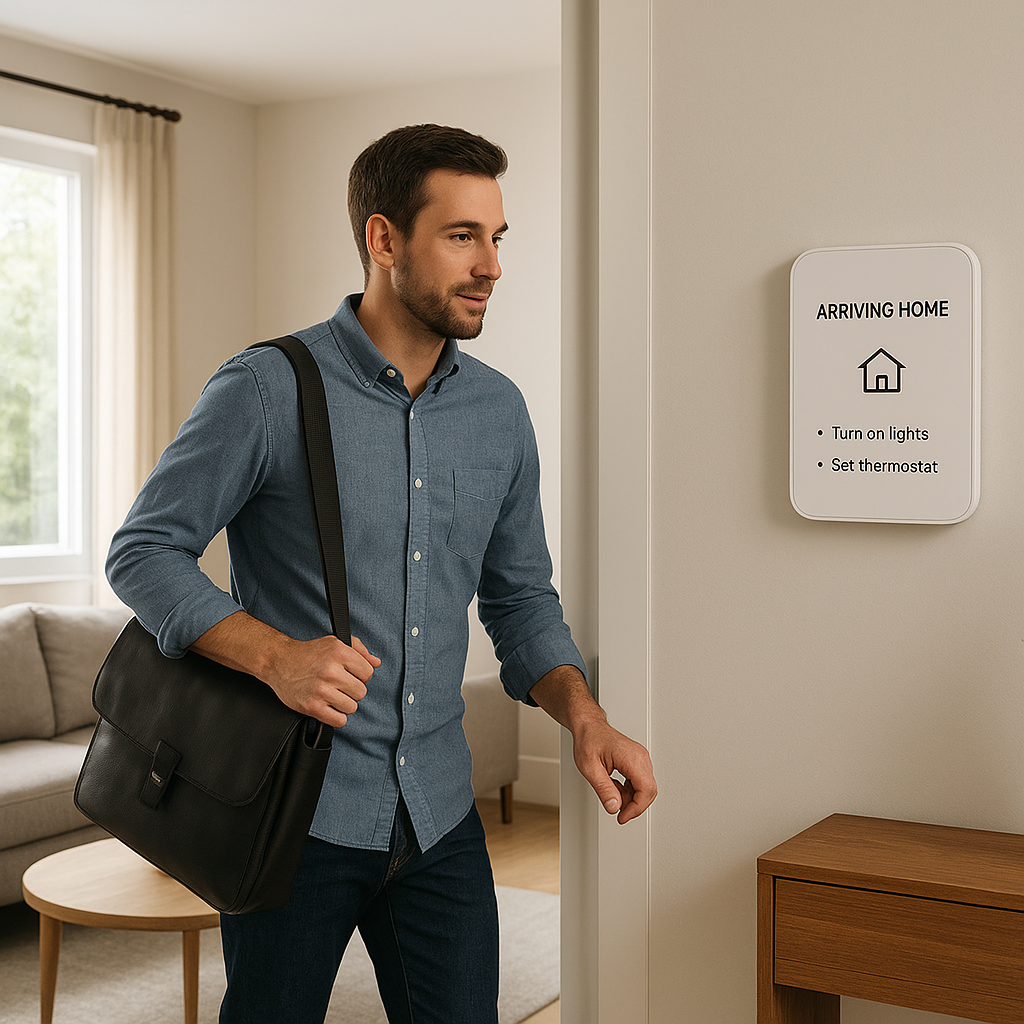
- Presence-based automations that turn on downstairs lights when the first person arrives home.
- Geofencing rules in SmartThings, HomeKit, or Alexa that treat the kitchen as part of your “Welcome home” scene.
If your kitchen lights come on predictably around dusk or when someone gets home, check these types of rules across every app you use.
Firmware bugs or compatibility issues after an update
Occasionally, a firmware update or app update changes how lights behave. Bugs can cause:
- Lights ignoring previous “power-on behavior” settings
- Duplicated or corrupted automations running twice
- Lights randomly toggling when reconnecting to a hub or router
These issues usually show up suddenly after things have worked fine for months. Checking for new updates or known issues in the vendor’s support pages can help confirm this.
How to Fix Smart Lights That Turn On by Themselves: Step-by-Step
Step 1 – Check and disable unwanted schedules
Start with the app you used to set up the device (Hue, Kasa, LIFX, etc.). For each kitchen light or group:
- Open the device settings and look for Schedules or Timers.
- Disable anything that turns the light on automatically, especially sunrise/sunset schedules.
- Check any “Wake up”, “Evening”, or “Goodnight” routines for included kitchen lights.
Repeat this for any secondary apps that might control the same lights (for example, Philips Hue app and also Apple Home or Alexa).
Step 2 – Review automations, scenes, and routines across all apps
Next, open your main smart home platforms one by one—Alexa, Google Home, SmartThings, HomeKit, or Home Assistant:
- Look under Routines or Automations.
- Search each automation for the name of your kitchen lights or kitchen group.
- Disable or edit any rule that turns them on at times you don’t want.
Also review Scenes. Even if a scene doesn’t mention “kitchen” in its name, it might still include those lights. Open each scene to see which devices it controls.
Step 3 – Inspect motion and door sensors in and near the kitchen
Walk through your kitchen and nearby hallways and note any sensors:
- Check their batteries and signal strength in the app; low battery can cause flaky behavior.
- Open each sensor’s settings and see which lights it controls and in which app (Hue app vs. HomeKit vs. SmartThings, etc.).
- Reduce sensitivity, shorten the auto-off timer, or temporarily disable the rule to see if phantom activations stop.
- Consider repositioning sensors so they don’t see areas you don’t want to trigger the kitchen lights.
If you use door sensors on a pantry or back door, check if their “door opened” automation turns on kitchen lights.
Step 4 – Adjust power-on behavior settings for each smart bulb or switch
Most modern smart lights let you change what happens after power is restored. In the brand’s app:
- Find the Power-on behavior, Power loss recovery, or Startup behavior setting.
- Change it to “Return to last state” or “Stay off” instead of “Always on”.
- Apply this setting individually to all bulbs and switches in the kitchen.
This single change often stops lights from randomly coming on after minor power blips.
Step 5 – Audit voice assistant history for accidental triggers
Open your voice assistant’s history:
- Alexa: App → More → Activity → Voice History.
- Google Assistant: App or web → My Activity → Assistant.
- Siri: Check Home app logs and any “Siri Suggestions” linked automations.
Look for entries around the times your kitchen lights turned on. If you see misunderstood commands, you can:
- Rename your kitchen lights or groups to more unique names.
- Disable voice control for those lights in the assistant app.
- Turn off always-listening microphones on devices in noisy areas if needed.
Step 6 – Reboot, update firmware, and re-sync your smart lights
If settings look correct but the problem continues, refresh the system:
- Power-cycle the lights or switches (off for 10–15 seconds, then back on).
- Restart your hub or bridge (Hue Bridge, SmartThings hub, etc.).
- Restart your Wi-Fi router if you use Wi-Fi bulbs like LIFX, Kasa, or Tapo.
- Check for firmware updates in the manufacturer’s app and install them.
After a restart and update, test again to see if phantom activations stop.
Step 7 – Factory reset as a last resort and re-add devices cleanly
If nothing else works and your smart kitchen lights still turn on by themselves, a clean start may be best:
- Remove the problem light or switch from all apps and hubs.
- Perform a factory reset using the manufacturer’s instructions (often a series of on/off toggles).
- Re-add the device to a single app first (usually the manufacturer’s), test it thoroughly, then link it to other platforms.
- Recreate only the automations you actually use, avoiding old or unused scenes.
This can clear out hidden or corrupted rules that are hard to track down otherwise.
Fixing Brand-Specific Issues (Philips Hue, Kasa, LIFX, and More)
Philips Hue: Hue Bridge rules, default power-on, and motion sensor tweaks
For Philips Hue:
- Open the Hue app → Settings → Power-on behavior and set kitchen bulbs to “Power loss: Keep lights off” or “Power loss: Last on state”.
- Check Automations in the Hue app for sunrise/sunset routines or “Coming home” automations that include kitchen zones.
- If you use Hue motion sensors, open each sensor in the app and verify which rooms and scenes they trigger, and at what times of day.
Also check if kitchen lights are included in Hue Labs formulas or experimental automations that you may have enabled earlier.
TP-Link Kasa and Tapo: Cloud rules, local schedules, and router settings
For Kasa and Tapo smart switches or bulbs:
- Open the Kasa/Tapo app and look for Schedules, Smart Actions, and Away Mode. Turn off ones you don’t need.
- Some Kasa devices can keep local schedules that run even if cloud access is down, so make sure both cloud and local schedules are cleared.
- If lights flash or reconnect often, check your router for frequent reboots or Wi-Fi instability; a stable network reduces odd behavior.
LIFX and other Wi-Fi bulbs: Network stability and in-app power behavior
For LIFX or similar Wi-Fi bulbs (Nanoleaf, Wiz, etc.):
- Open the brand’s app and check for Day & Dusk, Schedules, and Effects that might turn lights on at specific times.
- Confirm any power restore or startup setting is set to your preference (usually “Last state”).
- Ensure your bulbs have a good Wi-Fi signal; moving your router or adding a mesh node near the kitchen can help if bulbs are frequently dropping offline.
Smart switches (Lutron, Wemo, etc.): When the switch overrides the bulb
If you have smart switches controlling regular bulbs or even smart bulbs:
- Remember that a smart switch can override whatever the bulb wants to do. If the switch is programmed to turn on at 6 PM, it will power the bulb on regardless of app settings.
- In the switch’s app (Lutron, Wemo, Kasa, etc.), check for Schedules, Scenes, and Motion integrations.
- If combining smart switches with smart bulbs, consider simplifying: use one smart layer (switch or bulb) instead of both to avoid conflicts.
Network, Power, and Interference Problems That Trigger Smart Lights
How brief power blips make kitchen lights come back on
Even a split-second power interruption can reboot smart bulbs and switches. If their default startup mode is “on,” they will light up as soon as power returns.
Signs this is happening include:
- Lights coming on after storms, construction nearby, or heavy appliance use.
- Multiple lights in the same circuit turning on at once for no apparent reason.
- Other devices (like your oven clock) also resetting at the same time.
Combining proper power-on behavior settings with better surge protection can dramatically reduce these events.
Wi-Fi and Zigbee/Z-Wave congestion around appliances
Kitchens are tough for wireless signals. Metal appliances, tile, and wiring can weaken and reflect signals:
- Wi-Fi bulbs may disconnect and reconnect repeatedly if the signal is weak, sometimes flashing or turning on when they come back.
- Zigbee and Z-Wave devices rely on mesh networks; if powered repeaters (like smart plugs) are moved or lose power, routes can break and reform unpredictably.
- Microwaves and other devices can briefly interfere with 2.4 GHz Wi-Fi and Zigbee.
Placing your hub or router away from large metal appliances and ensuring enough always-powered devices in the mesh (for Zigbee/Z-Wave) can help.
Using surge protectors and UPS devices to reduce false activations
Surge protectors and uninterruptible power supplies (UPS) help smooth out small power events:
- Connect your smart hub or bridge (Hue, SmartThings) and Wi-Fi router to a UPS so they don’t reboot during brief outages.
- Use quality surge protectors on circuits with sensitive electronics to reduce voltage spikes.
- While you shouldn’t put fixed lighting circuits on consumer plug-in UPS units, stabilizing the network and hubs often prevents lights from receiving confusing signals.
When it’s actually a wiring or electrical issue (and you need an electrician)
Sometimes smart lighting behavior reveals underlying electrical problems:
- Lights flicker, buzz, or turn on and off rapidly without any app or automation involvement.
- Multiple circuits behave strangely at once, or breakers trip frequently.
- You see signs of heat damage at switches or fixtures, or lights glow faintly even when off.
If you suspect wiring issues, call a licensed electrician. Do not ignore electrical symptoms or attempt to fix wiring behind walls unless you are qualified. Smart lights can’t fix unsafe wiring and may behave unpredictably on a bad circuit.
Preventing Future Phantom Light Activations in Your Smart Kitchen
Best-practice settings for power recovery and default states
To keep your smart kitchen lights predictable over the long term:
- Set all bulbs and switches to “Return to last state” or “Stay off” after power loss.
- Avoid mixing different power-on behaviors on the same circuit; keep settings consistent.
- Review these settings after major firmware or app updates to be sure they haven’t changed.
Designing simple, conflict-free automations and scenes
Complex overlapping automations are a common source of confusion. A few design tips:
- Use one primary app to manage automations (for example, SmartThings or Home Assistant), and keep others simple.
- Limit each automation to a clear purpose—e.g., “Turn on under-cabinet lights on motion at night,” not a giant rule that controls every room.
- Document your main automations in a note on your phone so you remember what controls what.
Separating kitchen lights from whole-home routines when needed
If your kitchen is very active, you might not want it in every whole-home routine:
- Remove kitchen lights from generic scenes like “All lights” or “Downstairs” if those cause problems.
- Create separate scenes such as “Kitchen Bright,” “Kitchen Nightlight,” or “Cooking” that you trigger intentionally.
- Exclude kitchen lights from bedtime or away routines if they tend to wake people or attract attention when you’re not home.
Setting up activity logs and notifications to spot the cause quickly
Some hubs and apps offer logs or optional notifications when automations run:
- Enable logging in platforms like SmartThings, Home Assistant, or Homey to see exactly which rule turned on the lights.
- Temporarily enable push notifications when specific scenes or automations trigger your kitchen lights.
- Use this information to fine-tune or remove rules that fire more often than you expect.
When to Call Support (or an Electrician) About Smart Lights Turning On
Signs the problem is in your smart ecosystem vs. your wiring
To decide who to call, look for these patterns:
- Likely smart ecosystem issue: Lights appear in app logs as being turned on by a routine, sensor, or scene. Turning off that automation fixes the issue.
- Likely wiring/electrical issue: Lights flicker, randomly reboot, or behave strangely even when disconnected from smart control, or when the smart features are disabled.
If devices obey app commands perfectly but still turn themselves on with no logged trigger, start with vendor support. If the behavior is chaotic and affects non-smart devices too, talk to an electrician.
What information to collect before contacting vendor support
Before reaching out to Philips, TP-Link, LIFX, or your hub vendor, gather:
- Exact model numbers and firmware versions of the bulbs/switches and hubs.
- The approximate times and frequency of phantom activations.
- Screenshots of any relevant automations, logs, or voice assistant history.
- Details about your network (router model, mesh vs. single router, Wi-Fi band used).
This helps support narrow down whether you’re seeing a known issue, a configuration problem, or a defective device.
Safety considerations for lights switching on at night or when away
Unexpected lights are usually a nuisance, but they can also raise safety concerns:
- Bright lights turning on at night can disturb sleep, startle children, or create tripping hazards if people wake up disoriented.
- Lights turning on while you’re away might make you worry that someone is inside or that something else is wrong.
- If lights control fixtures near flammable materials (for example, halogen or incandescent bulbs near clutter), leaving them on for hours could pose a risk.
Until you resolve the problem, you can temporarily disable automations, turn off voice control for those devices, or switch them off at the wall if that’s safe for your setup.
Summary: A Simple Action Plan to Stop Smart Kitchen Lights Turning On by Themselves
5-minute quick fixes most homeowners can try today
If you only have a few minutes, try this fast checklist:
- Open your main lighting app and disable all schedules for kitchen lights.
- Set power-on behavior to “Return to last state” or “Stay off.”
- Check Alexa/Google/Siri history for accidental commands.
- Temporarily disable motion-based rules for any nearby sensors.
These steps alone fix most cases of smart lights turning on by themselves.
Long-term tweaks to keep your smart kitchen lighting predictable
For ongoing reliability:
- Keep automations simple and avoid duplicating the same rule in multiple apps.
- Review your scenes and remove kitchen lights from “whole-home” ones that cause issues.
- Stabilize your network and power with good Wi-Fi coverage, surge protection, and a UPS for hubs and routers.
- Periodically revisit settings and logs to ensure new updates haven’t changed how your lights behave.
With a bit of cleanup and a few smart defaults, your kitchen lights should only turn on when you want them to—no more phantom activations.
FAQ
Why do my smart lights turn on by themselves in the middle of the night?
Nighttime activations are often caused by motion sensors, sunrise/sunset schedules, or brief power blips that make bulbs default to “on.” Check for night-specific automations, reduce sensor sensitivity, and adjust power-on behavior to “stay off” or “last state.”
Can Wi-Fi issues make my smart lights turn themselves on?
Yes. If Wi-Fi bulbs or hubs disconnect and reconnect frequently, some will briefly turn on or toggle as they recover. Improving Wi-Fi coverage near the kitchen and rebooting your router and hubs can help reduce this behavior.
Why do only my kitchen lights turn on, not other rooms?
Kitchen lights are often included in more scenes and automations than other rooms, such as “Morning,” “Cooking,” or “Arrive home” routines. They may also be tied to motion sensors near entryways or pantries. Reviewing automations that specifically mention the kitchen usually reveals the cause.
Should I avoid using both smart bulbs and a smart switch on the same circuit?
Using both can work, but it increases complexity and the chance of conflicts—one may turn the other off or on unexpectedly. For simpler, more predictable behavior, use either smart switches with regular bulbs or smart bulbs with normal switches left on.
How do I know if my smart bulb or switch is defective?
If a single device behaves oddly after you’ve disabled automations, checked power settings, updated firmware, and reset it, it may be faulty. Test it on a different fixture or circuit if possible. If the problem follows the device while other lights are stable, contact the manufacturer for a replacement.